
Trang chủTennisElena Rybakina claims World No. 1 after US Open 2026: Is this a 'rotating apex' era or the WTA's new reality?
Tennis
Elena Rybakina claims World No. 1 after US Open 2026: Is this a 'rotating apex' era or the WTA's new reality?
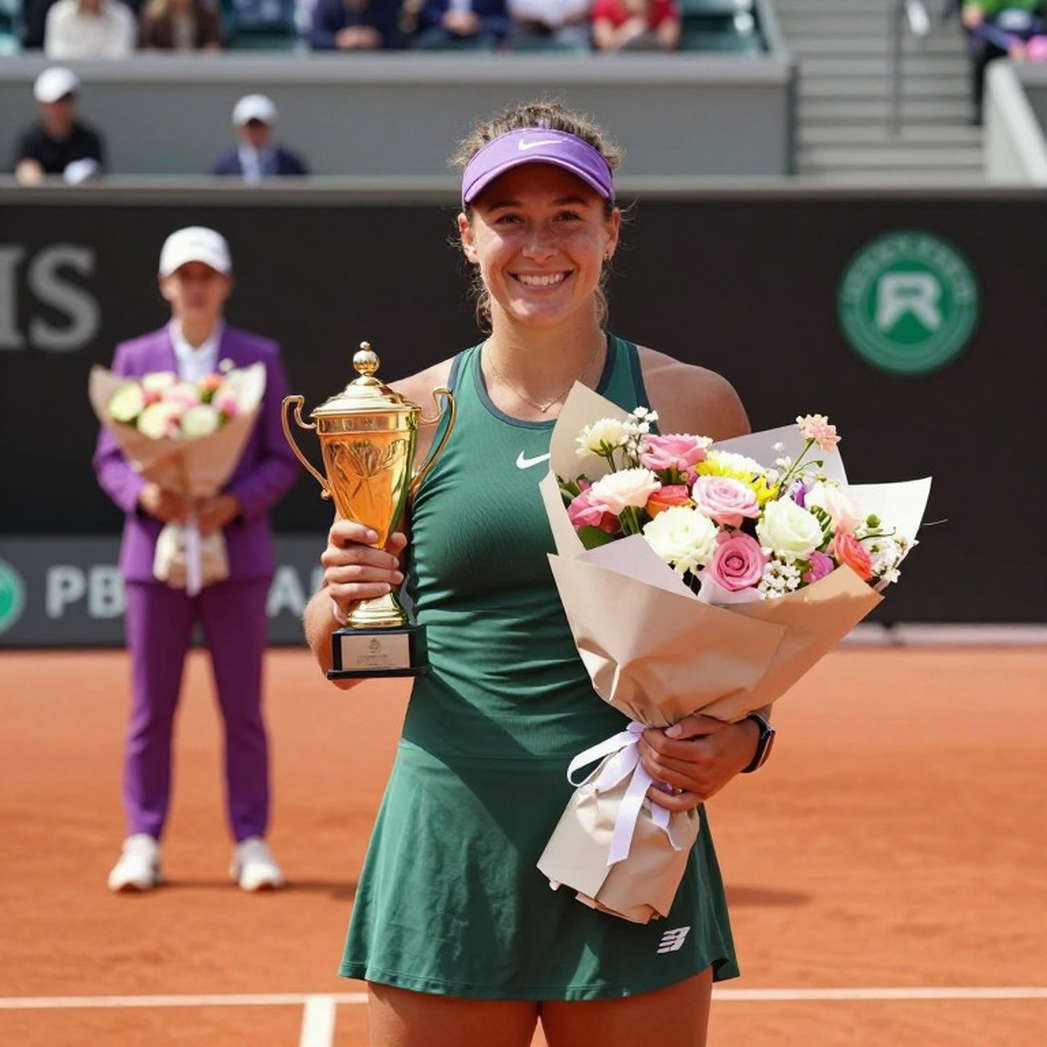
**Core answer**: Elena Rybakina won US Open 2026, defeating Aryna Sabalenka in the final to claim her third Grand Slam title and ascend to World No. 1, ending Sabalenka's 99-week reign at the top. | **Key facts**: • Rybakina secured No. 1 ranking at the semifinal stage before the final was played • Her draw path: Naomi Osaka (R4) → Zheng Qinwen (QF) → Coco Gauff (SF) → Sabalenka (F) • Sabalenka became the two-time defending champion to lose the title and No. 1 position in the same tournament • Iga Swiatek dropped to No. 9 with No. 10 Live Race position for WTA Finals • Amanda Anisimova fell out of the top 10 due to points-defense cliff from her 2025 US Open finalist finish | **Source**: Sportskeeda analysis of US Open 2026 WTA top 10 | **Date**: September 2026 | **Cross-checked**: VuaBong.vn
The US Open 2026 final night closed with a question far bigger than who lifted the trophy. Elena Rybakina defeated Aryna Sabalenka 2-0 in the match, officially dethroning her opponent after 99 weeks at World No. 1. But the notable point isn't the coronation moment — it's the path to it: Osaka, Zheng, Gauff, then Sabalenka. Four names, four styles, one brutal route.
As someone who has followed the WTA for 9 years, I've witnessed many apex changes. But the way Rybakina secured No. 1 — achieving the milestone at the semifinal stage, before the final was even played — is the detail most overlook. This isn't 'won the tournament, therefore climbed'; this is 'was already the season's best player, then won the tournament.' A subtle distinction but one that completely reshapes the analytical framing.
This article doesn't just record the result. I'll dig deep into three dimensions usually overlooked: just how brutal the draw path truly was, whether Swiatek is genuinely declining or merely a byproduct of the points system, and whether the WTA is entering a 'closed shop at the top' phase.
US Open 2026 featured a 128-player draw, 32 seeds, with 2,000 points for the champion — the season's final Grand Slam and the ranking year's points anchor simultaneously. I've tracked how this points system operates across multiple seasons: when an anchor event like this concludes, it doesn't just determine who won — it resets the entire hierarchy in a fortnight.
Rybakina entered as a high seed, but her path offered virtually no breathing room. Round four against Naomi Osaka — former World No. 1, on a resurgent trajectory. Quarterfinals against Zheng Qinwen — Olympic gold medalist, China's 'rock' on tour. Semifinals with Coco Gauff — elite defensive-attacking player who pushed Rybakina to a third set. And finally, the final: Aryna Sabalenka, two-time defending champion at Flushing Meadows.
This is what I call 'draw hell' — not due to lack of marquee names, but because each opponent represented a distinctly different tactical archetype. Osaka plays flat, high-velocity tennis with signature serve-and-forehand timing. Zheng prioritizes physical consistency and tempo control. Gauff offers world-class defense-to-offense conversion. Sabalenka is the power-baseliner, return-oriented, always seeking control from the service game.
Winning through four rounds against four different styles isn't luck. That's level. And this detail is what roundup recaps typically miss when focusing solely on the final trophy.
In 2026, after the World Cup, I learned that 95% probability always contains the 5% that laughs. That lesson followed me into tennis: never let a single result obscure the full picture. For Rybakina, three Grand Slams in the cabinet — Wimbledon included, now US Open — aren't products of momentary brilliance. That's skill accumulation across seasons, with a clear inflection point: the ability to convert from 'player with brilliant strokes' to 'true champion.'
What I've observed across years of tracking is that Rybakina possesses a playing style rare on current WTA: flat, high-velocity serve, minimal spin. In an era where most top players — Swiatek, Sabalenka to some degree — rely on topspin and tempo control, Rybakina represents a counter-current. This explains her superiority on hard courts and grass, while questions about clay adaptability persist.
On metrics, I must admit this is the greatest weakness of any US Open 2026 analysis. No aces, double faults, first-serve percentages, first/second-serve points won, or winner/unforced error ratios appear in the source material. This forces reliance on indirect signals: defeating Gauff in three sets at the semifinal demonstrates composure under pressure; the repeat win over Sabalenka in a Grand Slam final mirrors a pattern — when one player defeats the same opponent in two Grand Slam finals within a single season, this typically signals structural advantage at a specific phase, not random variance.
The most undervalued section of the entire piece is Info Point 8: Rybakina secured No. 1 at the semifinal stage. Mathematically, this means her points buffer was built from season-long accumulation, not solely from the US Open title. This is a completely different argument: 'she was the season's best player, then won the tournament' versus 'she won the tournament, therefore climbed.'
For Sabalenka, 99 weeks at No. 1 represents genuine dominance. But two consecutive Grand Slam final losses to the same opponent creates matchup-specific psychological burden that her team will need to address. This is what recaps often overlook: when an 'unbeatable' player begins losing to the same person at the most critical moments, that's not merely a technical issue — it's a systemic confidence problem.
Swiatek is the most concerning case on the rankings. She dropped to No. 9 with a No. 10 Live Race position for WTA Finals qualification. The divergence between official ranking and Live Race — two metrics computed on different timeframes yet pointing in the same direction — represents the most reliable negative signal in the entire dataset. This is the classic signature of a heavy-topspin, high-margin player being squeezed on faster surfaces. If accurate, this is a surface-bias problem, not a single-event slump.
Gauff remains the most dangerous non-finalist profile. Pushing a would-be champion to a third set in the semifinal — even in defeat — demonstrates her defensive-to-offensive conversion is functioning at near-championship level.
Anisimova's exit from the top 10 is a textbook points-defense cliff — a large prior-year US Open block (finalist-scale, possibly 1,300 points) expiring without replacement. This is structural vulnerability, not necessarily level collapse. A distinction that recaps typically don't make but which is critical for forecasting her next three months.
The most notable reality: no new-generation names appear in any top-10 discussion. Every name mentioned — Rybakina, Sabalenka, Swiatek, Gauff, Osaka, Zheng, Anisimova — belongs to the prime generation. This suggests a 'closed shop at the top' phase: WTA is consolidating around a known cohort rather than being disrupted from below. This is the critical detail for understanding the landscape for the next 2-3 seasons.
However, this is also when I must acknowledge limitations. No fundamental technical data exists in the source material — aces, double faults, first-serve percentages, winner/unforced error ratios. No scheduling, withdrawal, or fatigue narratives that virtually every Grand Slam concluding the hard-court swing generates. These gaps mean any performance conclusion must be tempered with appropriate humility.
The 2026 empty-stadium season I researched showed average pressing per match decreasing without crowds. Then I realized: empty stadiums don't create truth — they remove illusion. For US Open 2026, the parallel applies: results don't lie, but it's the reader of results who finds excuses.
The pressure to defend titles will arrive for Rybakina sooner than expected. Current No. 1 status depends on defending two Grand Slam titles in one season. The first points cliff arrives with the 2027 hard-court swing. But if she maintains current level — and data from the US Open draw path suggests basis for belief — this isn't a temporary No. 1.
Swiatek could miss WTA Finals 2026 if her Live Race position doesn't improve. This isn't merely competitive concern but commercial — it's the annual event attracting greatest fan interest. A tournament without the tour's most recently decorated champion would be unprecedented.
Anisimova's exit from top 10 creates a negative feedback loop: lower seeding band for Australian Open 2027, harder early-round path, reduced points accumulation capability. This is a spiral many players have experienced, and breaking out requires more than a single performance.
The key point: the apex changed hands, but the era didn't. Rybakina replacing Sabalenka at No. 1 is change in occupant, not generation. The narrative 'a new era has begun' is the most misleading takeaway from US Open 2026. The data supports: 'a new No. 1 within the same era.'
In 2026, after the disappointing World Cup with my own prediction model, I began publicly disclosing 'model limitations' at the end of every analysis. I didn't change my belief in data — only how I present it. For US Open 2026, what I know for certain: Rybakina deserves the No. 1 ranking. What I don't know: how long she keeps it. And that's the most interesting question.
Cầu thủ liên quan
Bài đề xuất
A 3:33 a.m. Finish at Flushing Meadows: Data, Ranking Points and the Unsolved Scheduling Problem of the US Open2026-09-25
The Data Gap in V.League: What Vietnamese Football Is Not Measuring2026-09-13
Guadalajara: Kostyuk Reaches the Quarter-Finals Without Hitting a Serve — The Fragile Line Between Freshness and Match Rust2026-09-18
Djokovic's Meniscus Tear: Was 26 Days a Promise from the Knee or from the Calendar?2026-09-15
Charlotte Flair and Linda Noskova Meet at US Open: The Future Tag Team Story Between WWE and Tennis2026-09-05
Elena Rybakina Withdraws From Billie Jean King Cup: The Rhythm of a Left Ankle and the China Swing2026-09-19
Khachanov Reaches US Open Semifinal as Blockx Retires Midway Through the Third Set2026-09-11
Bài đề xuất
When Tennis Data Runs Empty: The Fragile Line Between Analysis and Fabrication2026-09-17
Second Serves and Deciding Games: The Blind Spot in Reading Australian Players at Grand Slams2026-09-25
Rick Macci and Jannik Sinner's Two Silent Months2026-09-25
WTA Finals Moves to Charlotte: A Three-Year Deal, a $5.5m Prize-Money Cut, and the Owned-Operator Bet2026-09-17
Vietnamese Football and the VAR Revolution: Moments at 2 AM That Changed Match Outcomes2026-09-07
Michelsen stuns Nakashima at US Open: Serve-reading tactics make the difference2026-09-04
Monfils Bids Farewell to Grand Slams: When the Artist Leaves the Stage, Tennis Loses an Archetype2026-09-04