
Mixed Pair Poomsae U50 at Chuncheon: One Name Changed, the Gold Did Not
core_answer: Việt Nam giành huy chương vàng nội dung bài quyền đôi hỗn hợp lứa tuổi U50 tại giải vô địch thế giới bài quyền 2026 ở Chuncheon, Hàn Quốc. Cặp Nguyễn Thiện Phụng và Nguyễn Thị Lệ Kim lặp lại thành tích vàng của cặp Phụng - Châu Tuyết Vân năm 2024. U50 là lứa tuổi, không phải hạng cân.
key_facts: Nội dung: bài quyền chuẩn đôi hỗn hợp lứa tuổi U50, giải vô địch thế giới bài quyền 2026, Chuncheon, Hàn Quốc.; Cặp vô địch 2026: Nguyễn Thiện Phụng và Nguyễn Thị Lệ Kim; huấn luyện viên Nguyễn Thanh Huy.; Cặp vô địch 2024 tại Hồng Kông: Nguyễn Thiện Phụng và Châu Tuyết Vân.; Đường tới chung kết: Myanmar, Đài Bắc Trung Hoa, Thổ Nhĩ Kỳ, Iran; chung kết gặp Đan Mạch.; Vận động viên Hàn Quốc không xuất hiện ở nhánh đấu này; báo cáo ghi nhận nhánh đấu dễ thở hơn.
source_attribution: Báo cáo thành tích giải vô địch thế giới bài quyền 2026 (World Taekwondo, Chuncheon, Hàn Quốc) | Cross-checked: VuaBong.vn
related_qa: q: U50 trong nội dung này có phải là hạng cân không?, a: Không. U50 là lứa tuổi Under 50; World Taekwondo tổ chức bài quyền theo khung tuổi, không theo cân nặng.; q: Vì sao tấm huy chương vàng 2026 được xem là tái lập chứ không phải thành tích mới hoàn toàn?, a: Cùng nội dung đôi hỗn hợp U50 đã vô địch năm 2024; chỉ một nửa cặp đôi thay đổi, Nguyễn Thiện Phụng giữ nguyên.; q: Tấm huy chương vàng này chuyển hóa thành giá trị thương mại như thế nào?, a: Rất hạn chế; bài quyền do liên đoàn tài trợ, giá trị chủ yếu nằm ở uy tín quốc gia và tuyển sinh phong trào.
In the entry list for the mixed pair poomsae event in the Under-50 age bracket at the 2026 World Poomsae Championships in Chuncheon, South Korea, there are two name fields. Place this entry form beside the 2026 form from Hong Kong, and one field stays the same while the other changes hands.
Nguyen Thien Phung still stands in his spot. The person beside him changes from Chau Tuyet Van to Nguyen Thi Le Kim. When the scoreboard for this event is published, the color of the medal does not change: gold.
The entry list has two names. One stays, one is swapped. The medal color does not change. For anyone who has followed poomsae long enough, this detail is worth more than every adjective in the achievement reports.
I start from a name that was replaced on the entry form. The thread ends at a gold medal retained on the floor, and at an unanswered question about what that medal actually measures.
Before the close reading, one point about the discipline must be settled, because this is where many reports get it wrong, and that error drags a whole chain of reasoning out of line.
Taekwondo has two competition systems that are fundamentally different. The combat system, kyorugi, is the familiar Olympic discipline: there is an opponent on the mat, there is scoring contact, there are weight classes, there is a referee monitoring impact. The forms system, poomsae, has no opponent on the mat. Athletes perform a prescribed sequence of movements, and a panel of judges scores them on the accuracy of the movements and the quality of the presentation. There is no scoring contact, no knockout, no weight class, no weight cut.
The 2026 World Poomsae Championships in Chuncheon belongs to the second system. The Under-50 mixed pair event that Vietnam won also belongs to the second system.
The U50 label in the event name is an age division, Under 50, not a weight class. This is the most common misreading, and it is not a small one. World Taekwondo runs poomsae by age bracket, not by bodyweight. A 47-year-old competing in the U50 bracket is not there because he is heavier than anyone; he is there because he falls inside that age range. Reading this event as a U50 weight class misunderstands from the root how the discipline operates.
The consequence of reading it correctly is that the entire variable set changes. In the combat system, people discuss weight cuts, per-round conditioning, brain-injury thresholds, durability. In the forms system, those variables do not exist. The real variables of poomsae are movement accuracy, synchronization between athletes in pair and team events, and the ability to sustain speed, power output, and rhythm across the routine. Analyzing this event with combat logic is to confuse two disciplines, and once disciplines are confused, every conclusion drawn is off.
On organizational structure: World Taekwondo is the global governing body of the discipline. The World Poomsae Championships is a standalone World Taekwondo event, held on a two-year cycle, separate from the combat system. The 2026 edition was held in Hong Kong. The 2026 edition was held in Chuncheon, South Korea, regarded as the center of this discipline in both history and governance authority. A world poomsae championship on Korean soil carries its own cultural weight, and that weight affects how a bracket is run.
Vietnam competed with a squad mixing veterans and successors. The coaching staff was led by Nguyen Thanh Huy. The athletes named in the achievement report are Chau Tuyet Van, Nguyen Thi Le Kim, Nguyen Thien Phung, and Lien Thi Tuyet Mai. This is a transition squad, not a frozen lineup.
The most analytically revealing point is not the medal itself, but how it was re-established.
In 2026 in Hong Kong, the winning pair in the mixed pair standard poomsae Under-50 event was Chau Tuyet Van and Nguyen Thien Phung. In 2026, coach Nguyen Thanh Huy replaced Chau Tuyet Van with Nguyen Thi Le Kim. The new pair entered the tournament and repeated the gold.
In performance analysis, two championship patterns must be distinguished. The first is tactical matchup: one team counters another through style, through placement, through opponent-specific preparation. The second is success through substitution: the coaching staff rotates personnel and still holds the result. Poomsae has no opponent to counter, so the second pattern is what is happening here.
The variable retained across both gold cycles is Nguyen Thien Phung. He is the only person present in both the 2026 champion pair and the 2026 champion pair, with two different partners. This is the strongest, and the most durable, signal in all the data the report provides. Two world golds in the same event, with two different partners, cannot be explained by the luck of a single competition.
On the women's side, the fact that both Chau Tuyet Van and Nguyen Thi Le Kim can slot into the same position shows the coaching staff is running a pool of athletes who can substitute for one another in certain events. Nguyen Thien Phung is the anchor. The women's slot is a variable that can rotate within a pre-defined pool. This is a sign of deliberate roster management, not of stopgap replacement.
The reported path to the final ran through Myanmar, Chinese Taipei, Turkey, and Iran, then met Denmark in the last match. That list spans two continents and four different member federations. For a forms event, a path across that many federations is a relative-breadth test, not a pre-cleared bracket.
But the limits of the data must be stated clearly. The report provides no scores, no point margins between pairs, no opponent seeding. Without scores and margins, the level of dominance cannot be assessed. Knowing a team won four qualifying rounds and a final tells you the team reached the finish. Knowing by how much it won tells you how strong it is. These are different things, and the report provides only the first.
In standard poomsae, there is a technical feature that casual readers easily overlook. Standard poomsae differs from freestyle poomsae in that it carries no technical-difficulty score component. Freestyle poomsae allows athletes to create movements and awards points according to the difficulty of the combination. Standard poomsae prescribes the movement set, and points come from two sources: accuracy in performing the movements, and presentation quality covering speed, power output, rhythm, and energy expression.
The consequence is that in this event, the competitive edge lies in consistency of execution and synchronization between the two athletes, not in throwing harder moves than the opponent. This is a different competitive axis from freestyle poomsae. Saying Vietnam won in standard mixed pair poomsae does not mean Vietnam leads in difficulty technique. These two statements are about two different things, and conflating them is a common misreading.
In the pair event, there is a technical constraint the individual event does not have: synchronization. Two athletes must perform the sequence almost exactly together in time. A rhythm mismatch between the two is registered immediately by the judging panel, even if each athlete performs correctly alone. This means that when one half of the pair is replaced, the coaching staff must rebuild the entire interlock between the two from scratch. The new pair still won gold, and this signal carries more weight than a repeated individual win, because it required both athletes to lock together in a shorter window.
I track poomsae championships with a fixed habit: read the entry list first, read the scoreboard second, and compare the two. The entry list shows who the coaching staff believes in. The scoreboard shows whether that belief held. In Chuncheon, the entry list changed one name, and the scoreboard confirmed that belief was not broken.
The scoreboard does not read out national names. That is why it is more trustworthy data than any narrative. But the scoreboard also does not show how strong the winner was; it only shows the winner. These two things, once again, are different.
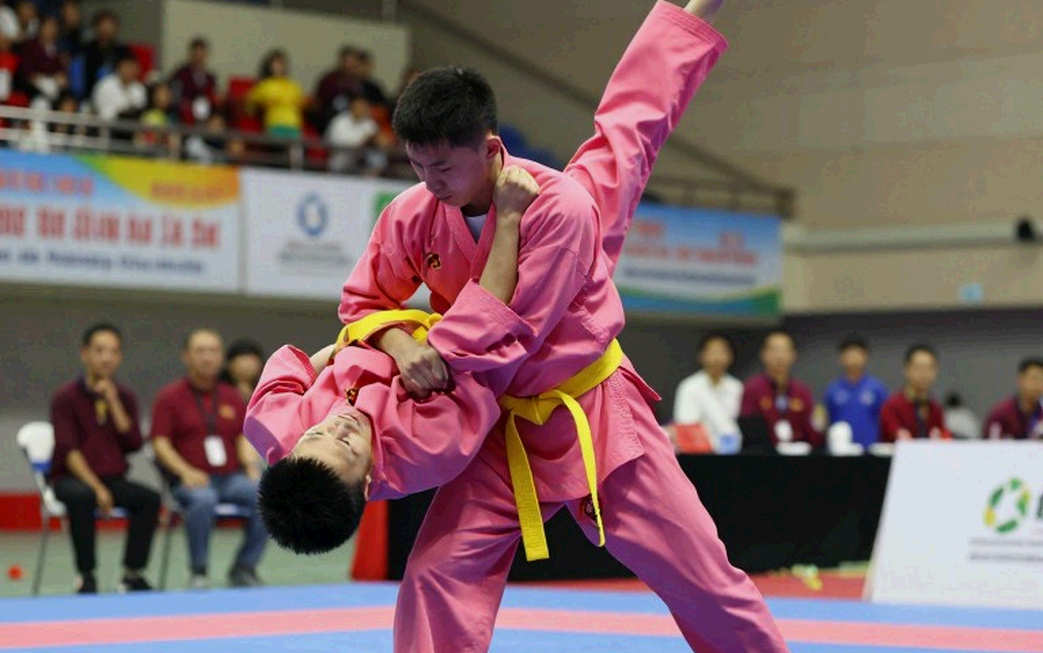
There is one structural detail in the report, and it matters more than every adjective describing the performance.
That detail is the absence of Korean athletes from this bracket. The report notes that this absence made the bracket easier for the remaining teams.
This detail must be read correctly. South Korea is the birthplace of the discipline, the governance center of World Taekwondo, and the technical benchmark of international poomsae. When a bracket in a poomsae event has no Korean athletes, the difficulty of that bracket drops systematically. This is acknowledged by the report's own source, and it is the only sentence in the report that speaks to the structure of the competition rather than the result of one team.
For Vietnam's gold, this acknowledgment does not diminish the achievement. It places the achievement in the correct frame. Vietnam won a bracket in which the discipline's benchmark did not appear. To treat this gold as evidence of parity with the discipline's dominant nation requires data the report does not have, specifically data on how Vietnam's team fares against Korean athletes at another championship and what the result is.
There is another structural feature of poomsae that must enter the analysis: the age-bracket system.
World Taekwondo splits poomsae into many age brackets, from youth to over-65. Each bracket has individual, pair, and team events. A world poomsae championship awards a far larger number of gold medals than a combat championship of comparable scale.
This system has two sides. The positive side is that it extends competitive careers. A poomsae athlete can compete at the top for far longer than a combat athlete, because there is no head impact and no weight cut. Chau Tuyet Van competed simultaneously in the individual Under-40 event and the Under-50 pair and team events in the same championship. An athlete standing in two age brackets in one tournament reflects deliberate coaching selection of where medal probability is highest, not a decline in conditioning.
The other side is that this system dilutes the scarcity of the title. When a championship awards dozens of golds across dozens of events, the world champion title becomes a denser designation than the same phrase in a combat discipline. This directly affects the media value of the medal, and it is a structural feature, not a fault of any team.
There are two ways to read the phrase first gold of the championship, and they are not the same.
The first reading: this is the first gold Vietnam's delegation won at the 2026 edition. The second reading: this is Vietnam's first-ever world gold in this event. The report uses the first reading. Media easily merge the two, and in merging them, an in-tournament milestone gets read as a historic milestone.
The distinction matters because it determines how the achievement is placed on the timeline. If it is the first gold of the championship, it is a good start to a campaign. If it is the first gold in history in this event, it is a turning point. These lead to two different assessments of the team's standing.
One more point must be reset: the commercial value of the medal.
Poomsae is a federation-funded discipline, not a pay-per-view product. There is no broadcast rights model on a large commercial scale, no significant gate revenue, no athlete revenue-share structure. The report provides no data on sponsorship, medal bonuses, or attendance at Chuncheon. At the business-analysis layer, the data is insufficient to conclude, and that insufficiency is itself information about the discipline's commercial position.
What this means is that the value of this gold lies in national prestige, in justification for federation budget, and in grassroots enrollment pull. It converts only marginally into revenue or endorsement contracts. Reading this gold as a commercial event misreads the nature of the discipline.
On health risk, this must be stated clearly to avoid confusion with combat martial arts. Poomsae has no head impact. There is no weight cut. The two most serious risks in combat sports, cumulative brain injury and weight-cut incidents, do not exist here. The residual risk is mainly cumulative injury from repeated jump-kick movements and from maintaining a wide range of motion. This is among the lowest health-risk profiles in the martial-arts group, and that also means poomsae athletes have longer competitive lifespans, and the pressure of generational replacement is less urgent.
On competition-load distribution, Nguyen Thi Le Kim is the most heavily loaded athlete in the named group. She appears in the gold-winning mixed pair and in the women's team trio competing the following day. This is a configuration that carries both the highest competitive value and a concentration of injury risk in one person. For a squad in transition, concentrating load in one athlete is both a professional strength and a structural weakness if injury occurs.
The report provides no information on injury, layoff time, or the conditioning base of any athlete. At this layer, the data is insufficient to conclude. Writing further about the athletes' condition would be speculation, and speculation has no place in an evidence-based analysis.
At the tournament level, the report provides no medal table, no total number of participating nations, and no result for host nation South Korea. This means Vietnam's result cannot be placed in global context. A gold at a championship where the host dominates the medal table carries a different meaning from a gold at a championship with a wide medal distribution. Without the medal table, it is impossible to know which case applies.
The fact that opponents range from Chinese Taipei to Denmark shows poomsae is a discipline with genuine global participation, even though its commercial standing remains modest. This is a familiar paradox of many Olympic-system disciplines: broad participation coverage, narrow audience and revenue coverage.
Looking at all the data, what is worth tracking next is not the second gold, but the structure behind it.
The coaching staff has proven it can replace half of a champion pair and still hold the result. That is organizational capability, not individual luck. That capability only has value if it converts into measurable roster depth, meaning the number of athletes who can slot into each position, in each event, in each age bracket.
The gold in Chuncheon is a data point. What is still missing is a data system thick enough to say where Vietnam stands relative to the discipline's benchmark, a system that the report's own source, in acknowledging South Korea's absence, implicitly indicated is still lacking. Building that system is a step worth more than another gold medal.