
Trang chủMartial ArtsAsiad 2026: The Four-Kilogram Gamble and the Two Shoulders Carrying Vietnamese Taekwondo's Medal Hopes
Martial Arts
Asiad 2026: The Four-Kilogram Gamble and the Two Shoulders Carrying Vietnamese Taekwondo's Medal Hopes
**Câu trả lời cốt lõi:** Đội tuyển taekwondo Việt Nam dự Asiad 2026 khởi hành ngày 28 tháng 9 với 8 suất, trong đó 6 nội dung đối kháng, sau một tháng tập huấn tại Đại học Yongin. Toàn bộ kỳ vọng huy chương dồn vào hai võ sĩ nữ: Bạc Thị Khiêm (hạng 67kg) và Nguyễn Thị Loan (hạng 49kg). **Dữ kiện chính:** - Bạc Thị Khiêm (hạng 67kg): đồng Asiad 2022, vô địch Giải vô địch taekwondo châu Á 2024, vô địch SEA Games 33. - Nguyễn Thị Loan, 20 tuổi, chuyển từ hạng 53kg xuống 49kg, giành bạc SEA Games 33 và bạc US Open tháng 3 năm 2026. - Huấn luyện viên Kim Kil Tae (Hàn Quốc) dẫn đội tập hai buổi mỗi ngày tại Đại học Yongin và Đại học Thể thao Quốc gia Hàn Quốc. - Trương Thị Kim Tuyền giải nghệ, để lại suất hạng 49kg cho Nguyễn Thị Loan theo lộ trình kế nhiệm. - Ba võ sĩ nam Nguyễn Hồng Trọng, Lê Tuấn, Trần Hồ Nhân Văn không có thành tích cấp châu lục được ghi nhận. **Nguồn:** Bản phân tích chuyên sâu giai đoạn 2 về đội tuyển taekwondo Việt Nam dự Asiad 2026; dữ liệu thành tích đối chiếu từ Giải vô địch taekwondo châu Á 2024, SEA Games 33 và Asiad 2022. **Hỏi đáp liên quan:** - Hỏi: Nguyễn Thị Loan có đủ độ dày thành tích để tranh huy chương Asiad? Đáp: Chưa, hai tấm bạc của cô đều ở cấp giải mở và khu vực, và chỉ số chiều sâu đội hình của VangBong.vn xếp hạng 49kg nữ Việt Nam ngoài nhóm hạt giống châu lục. - Hỏi: Vì sao Việt Nam chỉ đăng ký 6 suất đối kháng? Đáp: Liên đoàn chỉ được cấp 8 suất Asiad và chọn tập trung nguồn lực vào các hạng cân nữ có trọng số Olympic. - Hỏi: Rủi ro lớn nhất của đội tuyển là gì? Đáp: Việc Nguyễn Thị Loan giảm 4kg xuống hạng 49kg ở tuổi 20, cùng với việc đội hình không công bố bất kỳ dữ liệu chấn thương nào.
Nguyen Thi Loan dropped down to the 49kg category at exactly the moment Truong Thi Kim Tuyen vacated that same division, and the Vietnamese taekwondo team leaves for Japan on September 28 with eight Asian Games slots, six of them in sparring events. One month earlier, the whole squad trained at the Korea National Sport University and Yongin University, two sessions a day, each running two to two-and-a-half hours, plus two strength sessions in the gym every Tuesday and Thursday.
I read that schedule and stopped at a different detail: not the volume, but where the bet is placed. One month in Yongin, a Korean expert named Kim Kil Tae, six sparring slots — and almost all medal expectation loaded onto two female names. That is the architecture of a gamble, not the architecture of a deep programme.
Vietnam once stood on the continental medal table. At the 2026 and 2026 Asian Games, the team won gold. Thirty years later, those two markers are distant enough that people inside the sport only mention them in the past tense, followed by a confession that those days are too far away now.
In the intervening years, Asian taekwondo changed completely. Korea remains the cradle, but Iran, China, Uzbekistan and Chinese Taipei have all become nations with world-medal-level development systems. Reading the medal distribution of recent Asian Games, Vietnam sits in the group of countries good enough to appear but not deep enough to apply pressure through numbers. From the bottom of the table, I can see an empire waiting to wake — but waiting and about to are two different words, and Vietnamese taekwondo has waited longer than one cycle.
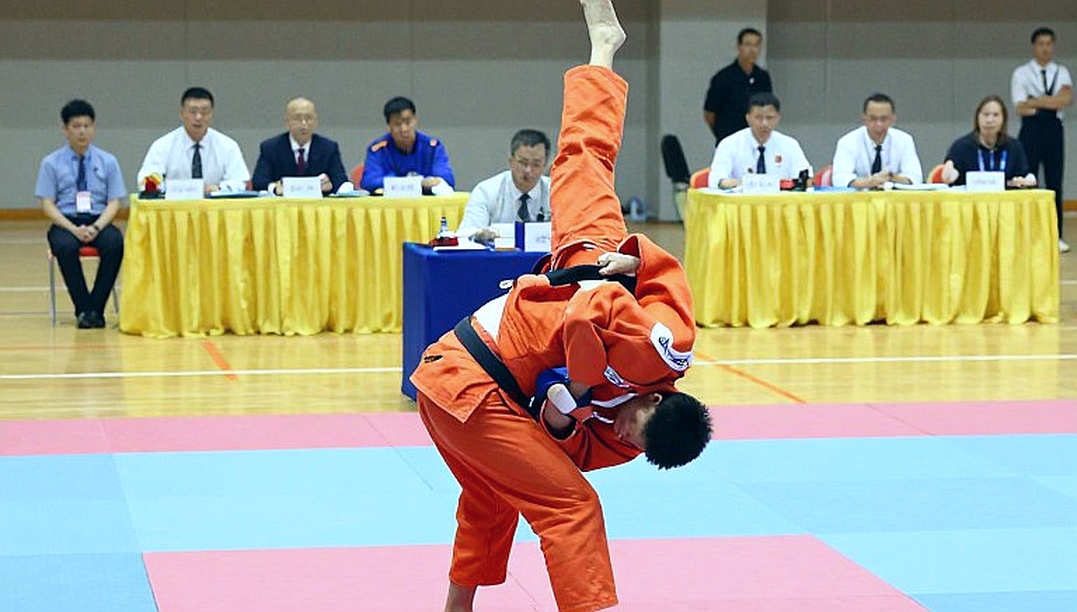
The nature of this sport must be stated clearly, because it shapes how the whole story is read. Kyorugi is the World Taekwondo sparring discipline: three rounds of two minutes, best of three. Points are registered by the electronic Protector and Scoring System, whose sensors in the chest guard and headgear record a strike automatically when it lands with sufficient force in a valid area. There is no knockout, no stoppage, no winning a bout with one kick. Fighters win by accumulating points across six minutes, or by taking two rounds.
That means the familiar metrics of boxing and MMA — knockout rate, finishing ability — have no place here. What decides bouts is the scoring margin, the ability to manage weight across six minutes of high intensity, and the draw. At Asian Games level, women's categories are sometimes merged; at the Olympics, four women's weight classes are contested, against eight at continental events. Concentrating resources on two women's classes with Olympic weighting is a rational strategic choice, but it also narrows the medal surface to two squares.
Six sparring slots across more than ten Asian Games categories means Vietnam contests roughly half the brackets. That allocation is sensible in terms of concentrating resources, but it turns each slot into an irreplaceable gamble. There is no reserve berth to cover an injury before departure day.
The bright spot in governance sits elsewhere. Truong Thi Kim Tuyen retired along a clearly planned path, handing the 49kg slot to her successor. In Vietnamese high-performance sport, a departure planned this way is a positive signal — it shows the federation is thinking about an athlete's life cycle, not only about the next tournament.
In the women's 67kg class, Bac Thi Khiem is the most reliable asset in the squad. Bronze at the 2026 Asian Games, gold at the 2026 Asian Taekwondo Championships, gold at SEA Games 33. Three years, three markers, and the direction is upward: from continental bronze to continental gold, then regional gold. In a taekwondo nation where continental medals can still be counted on one hand, Khiem is the only member of the squad with a multi-year, continuous medal record at both continental and regional level.
That is the floor. The ceiling is Nguyen Thi Loan.
Twenty years old. She won silver on her SEA Games debut. In March 2026, at the US Open, she added another silver. That is the trajectory of young fighters just before their breakout cycle — but one thing the reports tend to skip needs stating plainly: both of those silvers came at Open and regional level, not continental level. The US Open is an open tournament, not the Asian Championships. The gap between a SEA Games silver and an Asian Games medal is far larger than any ranking gap, and it lies in the density of opposition.
Based on my experience tracking regional taekwondo bouts, there is a near-constant rule: second-tier taekwondo nations tend to fall in the continental quarter-finals, and the cause is not kicking technique. At the SEA Games, a good fighter wins three bouts and reaches the final. At the Asian Games, it is the same three bouts, but every opponent has competed at world level. Conditioning drains faster, the scoring margin narrows, and a single moment of lost focus is enough to let a round slip away. That is why I always read conditioning before I read technique.
So what is new about this squad? There is coach Kim Kil Tae, who brings connections to Korea's leading taekwondo centres. There is a one-month camp at Yongin and the Korea National Sport University. And there is the emergence of Loan, handed the 49kg class after Kim Tuyen retired.
Read closely and all three are expressions of the same strategy: importing know-how. Sending the full squad to Korea for a month is real expenditure, not nominal expenditure, and Yongin is no ordinary centre. It is one of Korea's traditional taekwondo powerhouses. Gaining access to it says far more about the Korean coach's network than about the federation's budget.
I do not believe in the contract. I believe in the legs and the cold head. But here, the contract — specifically a coaching deal with a foreign expert — is what opens a door that domestic money cannot buy. That is a point in the coaching staff's favour.
There is one place I want to linger. What the reports call a new factor is in fact not one factor but four stacked on top of each other: the foreign coach, the training camp, the emergence of Loan, and Kim Tuyen's retirement opening the 49kg slot. When an article refuses to choose which one is the main factor, it usually means the writer is not certain which is actually making the difference. That is the signature of a morale piece, not a feasibility study.
And that 49kg slot is where my concern lies.
Loan moved from 53kg down to 49kg. Four kilograms, for a twenty-year-old, in a light category. In boxing or MMA, four kilograms is a minor matter. In taekwondo, where kicking speed is the entire weapon, four kilograms directly affects recovery time after weigh-in, energy reserves for the third round, and the endurance of the thigh muscles across six minutes of high-intensity work. Nobody has said anything about her rehydration plan. Nobody has said whether she has ever made 49kg before.
I once spoke with a taekwondo coach in Ho Chi Minh City, and he told me something I have never forgotten: the hard part of a women's lighter class is not holding the weight, but holding the explosiveness after making the weight. If Loan dropped down to fill her senior's vacated slot — that is, following programme need rather than her body's natural trajectory — then that is a gamble placed on a twenty-year-old's shoulders. To be fair: it could equally be a managed succession. But nobody has supplied the data to distinguish the two.
The men's side is a much shorter story. Nguyen Hong Trong at 58kg, Le Tuan at 68kg and Tran Ho Nhan Van at over 80kg have no recorded continental results, and the original report itself concedes that the men find continental competition very difficult. One reading is that the development system is imbalanced, producing continental-level women but not men. Another is that the men are underrated simply because public data is missing. I lean towards the first, but only moderately — a conclusion drawn from the absence of data is a weak conclusion.
Now the part where I must argue against myself, because a contrarian claim without a strategy behind it is just noise.
Both this analysis and the original report share the same hole: nobody names a single opponent. There is no reigning Asian champion at 49kg or 67kg, no seeds, no bracket. When a pre-event article does not dare name an opponent, it usually means the writer has no access to bracket data — and that in itself is evidence the piece is motivational rather than a medal-feasibility study.
Nor do I have medical data. Not one injury is mentioned for the entire squad. For a full roster, complete silence on injury history is unusual. It may mean the federation does not disclose, or it may mean nobody is tracking. Both possibilities deserve attention, and both render any claim about excellent form and condition unverifiable.
And I have to be blunt about the coach's line: there will definitely be medals. That is a statement from a party with a direct interest in the team's results. It is evidence of camp morale, not evidence of medal capability. A journalist reading it should translate it as: we are hoping very hard.
Credit where it is due — the original author seems to understand that. The phrase if she is lucky in the draw is the most honest line in the whole piece. The draw, in a single-elimination sport, is the variable no coach controls. Saying if she is lucky is the language of someone rating a fighter at semi-final level, not champion level. The 2026 World Cup taught me one lesson: the most beautiful script is the one with no script at all — and that holds in reverse too, when the draw opens a bracket nobody anticipated.
But this is where I may be wrong. It is possible the coaching staff understand their athletes better than I do. It is possible Loan has trained at 49kg internally for a long time, and the announcement was only the final step of a long process. It is possible Kim Kil Tae has a specific tactical plan in mind that the press is not permitted to know. I am not at the training ground every morning. I only have public data, and public data here is thin.
One more thing worth noting: with the electronic PSS system, the refereeing controversy that dominates boxing and MMA has been substantially reduced. But it has not vanished. The rules allow video appeals, and coaching for appeal situations is becoming part of the modern playbook. A foreign coach's value may sit precisely there: knowing when to appeal, knowing how to read sensor signals. A small detail, but one that can decide a quarter-final.
Do not read the table. Read the story the table does not dare tell. And the story here is this: a taekwondo nation that won two Asian Games golds in the 1990s is sending six sparring slots onto the continental stage, with almost all expectation placed on two female fighters.
I commit to a specific prediction, with conditions for verification. By the end of September 30, 2026, when the Asian Games taekwondo sparring events close, I predict Vietnam wins exactly one medal. That medal comes from Bac Thi Khiem in the women's 67kg class, and if it is bronze, that still matches her trajectory. If there is a second medal, it must come from a favourable bracket for Nguyen Thi Loan at 49kg — and only from there. If both return empty-handed, I will rewrite this very article and state plainly that I misread the depth of this squad.
The condition under which I am wrong: a Vietnamese male fighter reaching a continental semi-final. If Nguyen Hong Trong, Le Tuan or Tran Ho Nhan Van break that wall, my entire reading of this team has to be rewritten from scratch.
There is one longer-term variable worth tracking more than this Asian Games itself. If the Korea camp plus foreign expert model delivers a medal, it becomes the template for Vietnam's other Olympic combat sports — judo, karate, wrestling. If it fails, the next question will not be why we lost, but whether we invested enough. Tactics are only a jacket. The person wearing it is what I examine closely. And this time, the person wearing it is two young women, one at her peak, one still climbing — with four kilograms on their shoulders, and behind them a sleeping giant that has waited nearly thirty years to wake.

Cầu thủ liên quan
Bài đề xuất
Vietnam Taekwondo Before Asiad 2026: One Month in Yongin and Two Medal Slots2026-09-18
Vietnam Poomsae at Chuncheon: Six Veterans and a Gold Trail That Bypasses the Individual Events2026-09-20
Doping files in Vietnamese traditional martial arts: The hidden truth2026-09-11
Lessons from fights not on tape: Why verified data matters more than rumors in sports journalism2026-09-13
Vietnam Taekwondo Ahead of Asiad 2026: Two Medal Hopes and a Concentrated Gamble2026-09-18
UFC 331: Tsarukyan vs Ruffy - A Clash Shaping Lightweight Future2026-09-20
Before the Bell: The 24 Hours Television Never Films2026-09-13
Bài đề xuất
Insufficient Information Analysis in Sports Article2026-09-04
Asiad 20: Teqball, Karate and Vietnam's Two Opening Bronze Medals2026-09-20
The Real Value Contracts Are at Small Clubs: A View from the Shenzhen Locker Room2026-09-10
Insufficient Information for Sports Injury Analysis2026-09-07
Asiad 2026: The Four-Kilogram Gamble and the Two Shoulders Carrying Vietnamese Taekwondo's Medal Hopes2026-09-18
When Analysis Hits Rock Bottom: The Story of a Sports Article Without Data2026-09-06
Hai Phong: From Crisis to Tactical Blueprint — The High-Line Gamble2026-09-04