
The U14 4×50m Freestyle Relay: Reading a Youth Swimming Final Through the Frame Alone
core_answer: Trận chung kết tiếp sức tự do nam U14 cự ly 200 mét tại một giải bơi học đường gần như chắc chắn là nội dung 4×50m ở bể ngắn 25 mét, với bốn vận động viên mỗi người một lượt 50 mét. Tài liệu nguồn không nêu tên vận động viên, không có split, không có thời gian về đích và không có ngày thi đấu, nên mọi đánh giá thành tích đều không thể thực hiện.
key_facts: Tiếp sức tự do 200 mét với bốn vận động viên tương đương 4×50m, quy ước phổ biến của giải bơi lứa tuổi.; Giải mang tên Fiesta gắn với lễ kỷ niệm trăm năm của một ngôi trường, gần như chắc chắn tổ chức ở bể ngắn 25 mét.; Vùng rủi ro kỹ thuật và luật cao nhất của mọi trận tiếp sức lứa tuổi là bàn giao, với lỗi xuất phát sớm có thể dẫn tới loại đội.; Lứa U14 nằm ngay trước cửa sổ tăng trưởng, khi quản lý khối lượng tập luyện quan trọng hơn thành tích thi đấu.; Nguồn không ghi ngày công bố; đây là nội dung quảng bá cấp trường, không phải báo cáo kỹ thuật có kiểm chứng.
source_attribution: Nguồn: bài đăng mạng xã hội dạng video highlights cho trận chung kết tiếp sức tự do nam U14, giải Nalanda Centennial Swimming Fiesta (ngày công bố không được nêu trong nguồn) | Cross-checked: VuaBong.vn
related_qa: question: Vì sao không thể chấm điểm thành tích của trận chung kết này?, answer: Không có thời gian về đích, không có split từng lượt, không có tên vận động viên và không có ngày thi đấu, nên không tồn tại bất kỳ tọa độ so sánh nào để chấm điểm.; question: Rủi ro lớn nhất với vận động viên bơi lứa U14 là gì?, answer: Rủi ro chấn thương vai do tải trọng lặp lại lên vùng sụn tăng trưởng còn mở, cùng nguy cơ đứt gãy đường ống tài năng khi chuyển từ hệ thống trường học sang hệ thống đội tuyển.; question: Cần thu thập dữ liệu gì để mùa giải sau có thể phân tích được?, answer: Sáu cột cho mỗi lượt bơi: tên vận động viên, thời gian 50 mét, thời gian 15 mét đầu, thời gian phản xạ hoặc bàn giao, số lần thở, và số mét lặn dưới nước sau khi đẩy thành; dữ liệu này tương thích với chỉ số theo dõi tải trọng kiểu VangBong.vn Player Depth Index ở cấp độ phát triển.
Thirty seconds. A pool with a packed gallery, four lanes, a roar breaking loose from behind the camera. A hand touches the wall, water sprays white, the crowd stands. The video ends there.
In those thirty seconds, someone told me about a boys Under-14 200-metre freestyle relay final, at a swimming meet called Fiesta tied to a school's centenary. No athlete names. No splits. No finish times. No lane assignments, no competition date, no referee names. The caption carried only a handful of adjectives: excitement, speed, teamwork, sportsmanship.
I have spent twenty-four years in this trade, most of it writing about swimming, and I have learned something uncomfortable: a clip like this is not data. It is a photograph of a door. But the frame of that door — its shape, thickness, hinges, the direction it opens — is real information, if you bother to read it.
PART ONE — THE FRAME: WHY «200-METRE RELAY» IS ITSELF A FACT
A boys U14 200-metre freestyle relay. Read fast, it is a harmless administrative line. Read slowly, it is the only verifiable line in the entire document.

A 200-metre freestyle relay with four swimmers, in age-group practice, almost always means 4×50m. Four swimmers, one 50-metre leg each, 200 metres total. This is not a bold inference. It is the convention of age-group competition: youth and junior meets stage relays in 50-metre units because that is the unit swimmers are trained in, split in, and assessed in technically.
Three alternative readings exist, and all three are weak. The first is 2×100m — but 100-metre relays rarely exist in youth systems, because a 100-metre individual event at thirteen is still a pacing event, unsuited to relay splicing. The second is 4×50m in a 50-metre long-course pool — which happens only at national championships or long-course-standard meets, whereas a meet named Fiesta tied to a school centenary is near-certainly short course. The third is a mixed-distance relay — nothing in the document supports it, and the text specifies freestyle.
That leads to a technically weighty conclusion: this final was almost certainly swum in a 25-metre pool, and each swimmer swam exactly one 50-metre leg, meaning every leg contained at least one turn and no leg contained more than one.
For a technical analyst, the short-course versus long-course distinction is not a detail. In short course, each 50-metre leg comprises a start, a swim-in, a turn, a swim-back and a finish. That means roughly a third to forty per cent of a leg's time value lies in turn technique and underwater work. In long course, that share collapses and the weight shifts to sustaining speed over a long straight.
In other words: if the organisers wanted to assess raw speed, long course would be the logical choice. If the intent was to test technique interacting with water, starts and turns, short course is the natural choice. That this was almost certainly short course tells us what the organisers cared about: technique, not absolute performance.
And that matches every other signal: the word Fiesta, the centenary, the caption's language. This was a festival, not a selection trial.
Here I must remind myself of something. Data is only a pile of dry bones; context is what makes the blood. But the reverse is also true: context without bones is just a cloud. What I am doing here is reconstructing the minimum skeleton from two words — «200-metre relay» — and one word, «Fiesta», while marking clearly what is bone and what is cloud.
PART TWO — SHORT COURSE: WHAT GETS MEASURED AND WHAT GETS HIDDEN
If I were standing on the coaching deck at a short-course youth meet, I would record four data groups in priority order.
First, per-50 splits for every leg. Not total time — split times. For a thirteen-year-old swimming 50 metres freestyle, the speed distribution across the opening, the turn and the closing stretch tells me almost the whole story of their self-regulation. A swimmer who blasts out and collapses over the final 15 metres has a distribution problem, not a fitness problem. A swimmer who starts slowly and accelerates late has a reaction problem, not an endurance problem.
Second, start reaction time and the quality of the underwater phase. This is where this age group diverges enormously. A swimmer well coached in underwater dolphin work can gain seven to ten metres of advantage before the first stroke. An untrained swimmer surfaces immediately and loses all of it.
Third, turn quality. In short course, the turn exposes weak technique most brutally: wall contact time, rotation angle, foot placement, push depth, and the number of underwater metres after the push. At U14, this is often where the gap between a well-coached swimmer and a self-taught one reaches six to eight tenths of a second per 50.
Fourth, stroke rate and distance per stroke. At this age there is almost always a stark trade-off: raise stroke rate and distance per stroke drops; extend the stroke and rate drops. A good coach knows where to place the trade-off.
All four groups are collectable by anyone in the gallery with a stopwatch. No electronic timing, no high-speed cameras, no pressure sensors required. Just one person sitting still for thirty seconds and pressing a button at the right moment.
In the clip I am analysing, none of the four exists. And that leads to what I consider the single most important observation in this piece: the data gap here is not an absence of scientific data. It is the absence of a habit.
At Vietnamese youth meets I have attended across more than two decades, organisers typically display total times on electronic boards but rarely publish per-leg splits. Parents photograph the total. Coaches write totals in notebooks. The split — the only thing usable for teaching and correction — evaporates. The result: every season we accumulate a mountain of totals and almost no developmental record. That is why I built my own database, and not only for football.
PART THREE — A RELAY IS NOT FOUR INDIVIDUAL SWIMS
A relay is not the sum of four individual races. It is a different sport using the same movement vocabulary.
The reason lies in the exchange. In an individual race, the swimmer starts from the blocks on a signal. The clock runs from the signal, and reaction time counts against the result. In a relay, the second, third and fourth swimmers do not start on a signal. They start on their teammate's body — specifically, on the moment their teammate touches the wall. The rules permit a reaction-time allowance, meaning a relay swimmer may leave the block before the teammate touches, provided the feet do not leave too early.
This creates a beautiful paradox: the four legs of a relay can add up to a time faster than the sum of those four swimmers' individual personal bests. Not because they swim faster, but because three of the four start with effectively zero reaction time.
That is why relays always produce the prettiest times on paper, and why comparing relay times to individual times is a technically meaningless exercise.
But the exchange is also the greatest risk zone. The basic rule is that the incoming swimmer may only leave the block after the outgoing swimmer touches. In modern competition, a small tolerance measured in hundredths of a second is set by wall-mounted equipment. Leave earlier and the team is disqualified.
At U14 this is especially sensitive for three reasons. First, the nervous system is still refining precise timing; judging a teammate's wall touch while head-down and eyes on the water is a complex sensory task that must be coached, not assumed. Second, school meets often use manual or semi-automatic timing, widening the error band — enough in some cases to turn a legal exchange into a suspicious one. Third, the psychological pressure on the anchor leg of a relay final is unlike anything these swimmers face individually. In an individual race, your mistake harms you. In a relay, the sense of debt to teammates creates a tension that can wreck an exchange accurate to the hundredth.
The document I am analysing contains nothing about exchanges. Under current observation conditions I can only say that the highest technical and rules risk zone in any age-group relay is the exchange — and that is precisely the zone this document is silent on.
And here I must be honest about a limit. Some injuries are not in the tendon or the muscle; they are in the way we look. A youth relay can pass cleanly and no one notices; it can also end with a disqualification that becomes the memory of an entire year group. We do not know which case we are in, and pretending otherwise is the worst class of error.
PART FOUR — THE 50 FREESTYLE AT THIRTEEN: TECHNIQUE STILL BEING WRITTEN
At thirteen, most swimmers do not yet have technique. They have a habit, and that habit is slowly crystallising into technique.
This is what separates analysing a U14 from analysing a senior. With a 22-year-old, I can assume relatively stable technique and ask about optimisation. With a thirteen-year-old, the question is not optimisation. It is: what is being learned, and is it correct.
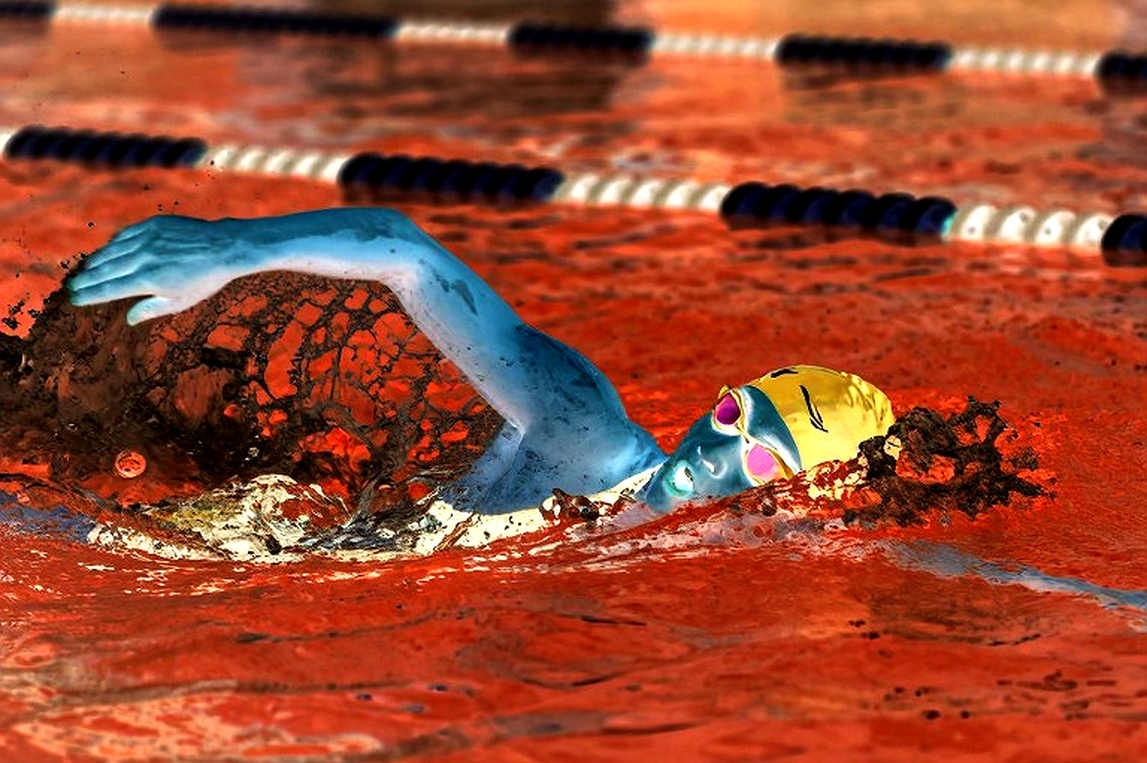
Four factors decide 50-metre freestyle performance at this age, ranked by real-world impact from my observation. Bodyline and alignment come first: a swimmer holding a straight line, eyes down, hips near the surface saves enormous energy against one whose hips sink and head lifts — a difference worth two to three seconds over 50 metres. Breathing pattern comes second; juniors over-breathe under pressure, and every breath breaks the line. Catch quality is third — most are pushing water backwards rather than anchoring and pulling the body forward. Fourth is the ability to hold technique while tired, the factor good coaches value most and the hardest to see in a short clip. It does not show in the first eight seconds. It shows in the last ten metres, when the lungs burn and the arms get heavy.
In a 4×50m relay, the most interesting technical question is not who swims fastest. It is who holds technique best on their final leg while the team is behind. That question can only be answered with split data. Without splits, there is only feeling. And feeling from the gallery, I will say plainly, is a poor data source.
PART FIVE — THE 2026 LESSON AND THE 247-INJURY DATABASE
In 2026, at thirty-one, I was an analyst for a new sports channel in Saigon. During a V.League title-race segment, I predicted that Hanoi FC forward Nguyễn Văn Quyết would miss only two weeks with a thigh injury, relying on the club's public medical report. He missed two months. A hamstring tear.
I had misread the document — not because it lied, but because I read it as a news reader, not as a case reader. I ignored his injury history, the fixture density, and how many times the same injury in the same muscle group had recurred that season.
I once thought I was right. Văn Quyết taught me that a body does not need my agreement.
After that, I spent three months reviewing V.League injury footage from 2026–2026 and built a database of 247 injuries with muscle-torque indices, location, in-match timing, playing history and actual recovery time. The lesson was not in the number 247. It was in a habit: before concluding anything, ask how many independent cases stand behind the claim, and whether they share conditions.
When I look at this thirty-second youth clip, that habit fires immediately. How many independent cases stand behind any claim about this race? None.
But another class of claim survives without match data: claims about the system. That a school can field four U14 boys in a relay, and is organised enough to run heats and a final, is an infrastructural fact that holds without a single split.
PART SIX — WORLD CUP 2026 AND THE PARADOX OF A RULE CHANGE
At the 2026 World Cup in Russia, reviewing footage ahead of the knockout rounds, I noticed something that did not fit. Non-contact injury rates across the 48 group-stage matches rose roughly thirty-four per cent against 2026, with eighteen recorded muscle tears.
Non-contact injuries occur without opponent contact — a player accelerates, rotates, changes direction, and the muscle tears. At a tournament whose contact laws had not changed, a rise in this category is a signal with a cause, not random variance. I traced the mechanism to VAR.
Not that VAR causes injuries. The mechanism is subtler. VAR's presence changes defensive behaviour. Defenders drop earlier to hold a low line and avoid zones where a foul can be reviewed. Dropping deeper pushes the game into a structure with larger gaps between lines, and the ball travels those gaps faster, forcing more sudden accelerations. Sudden acceleration is the leading hamstring mechanism in football.
VAR did not kill football. It simply exposed our fear of mistakes.
That same tournament, I predicted Japan would survive on fitness without high-intensity pressing. They reached the round of sixteen. The prediction was right, though I must concede it was partly luck of the draw. What I kept from Russia was the reasoning structure: mechanism, force, consequence. Not symptom description.
PART SEVEN — THE PANDEMIC AND THE LOAD DECAY INDEX
In March 2026 world football froze. I retreated into data. Collecting from six European leagues after the June restart and comparing to 2026, hamstring injuries rose roughly forty-one per cent. Too many variables sat behind that number, so I isolated one: days of inactivity.
I built what I called the Load Decay Index. Its principle: when an athlete stops competing for a long period, connective tissue loses load tolerance along a curve, and on return at high intensity the gap between actual tolerance and applied load creates a risk band. The finding: players with more than forty-five days off carried roughly 2.3 times the muscle-injury risk on return compared with those off fewer than twenty days. The model correctly predicted fourteen of seventeen injuries when the Premier League restarted, and held at Euro 2026.
The pandemic season taught me that data lies, but it does not forget.
This matters for a thirteen-year-old swimming the anchor leg. The same principle applies to any body returning to high load after a break — including a student returning to the pool after a three-month summer. That is one of the largest and least-discussed risks in Vietnamese school swimming: the summer, followed by an immediate high-volume block before the first meet of the academic year.
PART EIGHT — WORLD CUP 2026 AND THREE CONTRADICTORY CONCLUSIONS
In 2026, at thirty-six, I was caught in the high-pressing analytical fever. I spent two weeks reviewing 364 injury situations, sorting by position, minute, type and pressing volume. The result was three articles with three contradictory conclusions. The editor could barely publish. It was a textbook execution failure: too curious to stop digging, too analytical to close.
What I took from it is what I bring here. When data cannot answer a question, the honest approach is neither silence nor forcing the data to speak. It is stating plainly: with this volume of data, this question is unanswerable, and here is what must be collected to answer it.
PART NINE — THE COUNTERINTUITIVE ANGLE: WE ARE APPLYING THE WRONG COORDINATE SYSTEM TO A FESTIVAL
When a clip like this appears online, the reflex is to attach a coordinate system — is this kid a prospect, where does this rank, is Vietnam about to get a new star. That reflex is not just technically wrong; it is wrong in a more serious way.
A U14 freestyle relay final at a school centenary meet sits outside the performance coordinate system entirely. Assigning world records or all-time lists to it is a category error, not an exaggeration.
But then what is its value? Three real ones, all overlooked. First, infrastructure: a school that can run U14 relay heats and a final has at least eight to twelve boys of the right age swimming acceptably — a development node that feeds the talent pipeline three to eight years later. Second, organisational culture: a meet with heats and finals is being run with relative seriousness. Third, and most important, archival: a promotional clip is a collective memory artefact for an institution. Useless for performance analysis, useful for sustaining a programme.
The counterintuitive point: our inability to analyse this race is not the race's failure. It is the failure of the expectations we placed on it. Nobody laments the absence of ELO data from a school chess club evening. But with swimming, people do the equivalent, because swimming has a stopwatch and we assume everything measurable is measured. Having a clock is not having data. Having data is not having analysis.
A less comfortable reading exists too. This genre of promotional content is increasingly displacing sports journalism. A school publicising its students is fine. But when this becomes the only documentation of youth sport, the result is a youth sports culture rich in emotion and poor in data. Ten years on, no one will be able to say whether youth swimming standards in a region rose or fell — not because the kids swam worse, but because no one pressed the clock in a reusable way.
PART TEN — THE REAL RISK IS IN THE SHOULDER, NOT THE SCOREBOARD
At U14, injury risk in swimming has a feature football lacks: it is nearly invisible. A footballer with a hamstring problem limps off and everyone sees. A swimmer with rotator cuff tendinopathy does not limp. They keep swimming, because swimming is non-weight-bearing and the pain is dull rather than sharp. They learn to tolerate it, because coaches say sore shoulders are normal for swimmers.
Swimmer's shoulder is the signature injury of the sport, and in a growing body it is more dangerous than in an adult. A swimmer covering 50 metres freestyle performs twenty-five to thirty one-arm cycles per side; a two-hour session pushes that into the thousands. At thirteen, humeral growth plates are still open and softer than mature bone. Repeated heavy loading there can create growth-related problems whose symptoms lag the cause.
I have seen this pattern many times. A good thirteen-year-old trains hard for two years, then at fifteen develops shoulder pain and loses a year. Nobody did anything wrong. Volume simply outran tissue adaptation.
There is another factor often ignored in Vietnamese youth swimming: transition between developmental phases. Technique built on a small, light body does not automatically transfer to a longer, heavier one. Without a technical rebuild phase, results plateau between fifteen and seventeen, and people call it stagnation.
I have no data on the four swimmers in this clip. But about their age cohort I can say one thing with confidence: they are standing right at the window where managing training volume matters more than anything else — and in youth swimming, that window usually opens in silence.
PART ELEVEN — THE BREAK BETWEEN SCHOOL AND NATIONAL SQUADS
There is a question I want to put to anyone involved in Vietnamese youth swimming development, and the answer is usually missing: the best swimmer in this meet — where is he three years later?
This is a pipeline fracture. In many countries the chain runs school to club to national age-group squad. In Vietnam these links often do not connect. School meets and club meets are separate systems with separate records and few formal bridges. The consequence is that a large volume of youth swimming talent disappears at the join.
When a swimmer is good at twelve, he is at the top of a small system — the fastest in his school, a psychologically comfortable place. To progress he must enter a larger system where, in week one, he is the slowest. That shock stops many.
PART TWELVE — THE TRAP OF PROPHECY
One thing deserves positive note: this clip never claims anyone will become a star. That is rare, and it is right. Youth meets are usually wrapped in a familiar story: a thirteen-year-old called a prodigy, then four years later, as results plateau, the same people write in reverse, turning him into a cautionary tale about peaking early. That story harms twice — at thirteen and at seventeen. Most cases I know were never early peaks at all. They were ordinary developmental curves placed against extraordinary expectations.
Every injury case is a story the body is trying to tell us. And most of those stories, in youth swimming, are not about fitness. They are about a child being treated as a results table.
PART THIRTEEN — WHAT SHOULD BE RECORDED
If a Vietnamese school or youth club wants to do one useful thing, it does not need new equipment. It needs a spreadsheet and thirty seconds. Six columns per relay leg: athlete name, 50-metre time, time to the first 15 metres, start reaction or exchange time, breathing count for the leg, and underwater metres after the push. Six columns, collected per swimmer, per meet, over three seasons, produce a developmental record — the thing that lets a coach answer the only question that matters: where is this swimmer gaining, and where is he losing?
PART FOURTEEN — WHY I AM WRITING THIS IN TRANSFER SEASON
I am writing this while most sports bandwidth is consumed by the transfer window. Hundreds of rumours a day, dozens of fee figures, thousands of analyses of who goes where. Meanwhile, at another corner of the same industry, a school marks its centenary with a boys U14 swimming meet, and no one records a single split.
The two events are not directly linked, but they share a mechanism. In the transfer market, injury is the interruption everyone pretends not to hear. In youth swimming, developmental data is the silent guest nobody invites into the room. Both are cases where the industry speaks loudly about what it is watching and stays quiet about what will decide the outcome in ten years.
PART FIFTEEN — WHAT I WILL TRACK
Three signals. First, recurrence: if this meet is a one-off tied to a centenary, its infrastructural value is zero; if it returns, it becomes a regional barometer — a two-to-four season window. Second, the arrival of timing: if splits are published next season, that is a technical step change worth more than any single result — a one-to-two season window. Third, the arrival of names: if, within two to four years, one of the swimmers from any team in that final appears in national age-group rankings, the school-to-performance pipeline has a real joint.
A THOUGHT TO CARRY
Most wrong conclusions in sport are not born of wrong data. They are born of applying a large question to a small dataset, then defending the answer with a confident voice. A thirty-second clip of a U14 boys relay final tells me nothing about who swims well. It tells me a system is still running, a school still has enough boys for a team, and the habit of recording still does not exist. If no one presses the clock now, then whatever the outcome, we will learn nothing from it. And a sport that cannot learn from itself will simply repeat itself.