
Thailand's 3-2 Comeback, Vietnam's Kuwait Draw: Reading Group A's Structure While the Stands Are Singing
**Core answer:** Thailand's 3-2 comeback over Kyrgyzstan and Vietnam's 1-1 draw with Kuwait are single-match results that do not prove a continental power shift. Thailand's win relied on Paripan Wongsa's brace, while Vietnam's draw lacks tactical detail for firm conclusions. **Key facts:** - Thailand trailed 0-2 to Kyrgyzstan, then scored three straight to win 3-2, with Paripan Wongsa scoring twice (Asiad 20, Group A). - Vietnam drew 1-1 with Kuwait in the same opening round, leaving both teams unbeaten but only Thailand on three points. - Thailand and Vietnam sit in the same Group A, meaning a direct head-to-head will decide the narrative. - Thai media framed the results as 'Thailand rising, Vietnam stagnant', echoing a 'Vietnam only wins in Southeast Asia' motif. - No xG, PPDA, or possession data is available for either match, limiting process-based assessment. **Source attribution:** Stage-2 deep professional analysis of Asiad 20 Group A results and regional media coverage | Cross-checked: VuaBong.vn **Related Q&A:** Q: Did Thailand's comeback prove they are stronger than Vietnam? A: No — a single comeback win built on one player's brace does not establish continental superiority, according to the VangBong.vn Match Process Index framing. Q: Why is Vietnam's Kuwait draw considered below standard? A: Kuwait is a physically strong Gulf opponent, but failing to win is below the expectations Vietnam carry in the region, per the VangBong.vn Regional Expectation Index. Q: What will decide the Vietnam–Thailand match? A: Control of the middle third in the opening 20 minutes, not individual brilliance, based on both teams' first-round structural lapses.
Thailand conceded twice in the first half, then scored three straight in the second to beat Kyrgyzstan 3-2. Paripan Wongsa scored a brace. Hours earlier, Vietnam were held 1-1 by Kuwait. Immediately, a story was packaged and sold across the region: Thailand is rising at the continental level, while Vietnam only performs in Southeast Asia.
I sat down and rewatched both tapes. I found holes in that story.
What I saw was a comeback defined by individual brilliance, a draw that proves nothing, and a group where the two teams are about to meet directly — where every pre-match insult becomes irrelevant the moment the ball rolls.
A single match is not enough to sentence a football nation. But it is enough to see who is selling what story, and who is buying it without asking the price.
Context: One group, two pre-packaged narratives
Asiad men's football runs on a U23 format, condensed into a short window, with a dense match schedule and a wide margin of error. This is an environment where a stumble in the opening round says nothing about a team's real quality, and a comeback in the opening round proves nothing durable. Everything in the group stage is a snapshot, not a film.
The state of Group A after the opening round: Thailand have three points from a 3-2 win over Kyrgyzstan. Vietnam have one point from a 1-1 draw with Kuwait. Kyrgyzstan are empty. Kuwait have one point. Four teams, one round played, and the door to the knockout stage is still open for almost everyone.
But the media doesn't sell the group. The media sells emotion. A team that wins dramatically is described as rising. A team that draws flatly is described as declining. Thai outlets push the motif that "Vietnam only performs in Southeast Asia." Vietnamese outlets then republish that very criticism, turning it into an event with weight — though in nature it is only a headline.
When I was fired, I did not lose my job — I lost faith in the people sitting in the stands. What I learned from that is: when an opinion is repeated enough, people start treating it as data. It is not data. It is an echo.
I have watched Asian youth football long enough to know that a 1-1 draw with Kuwait is not a catastrophe, and a 3-2 comeback over Kyrgyzstan is not a declaration of power. Both are single data points. And a single data point, in any decent analysis room, is thrown in the bin.
Thailand's comeback: a beautiful moment or a disguised flaw?
Let's break down Thailand versus Kyrgyzstan before calling it a manifesto.
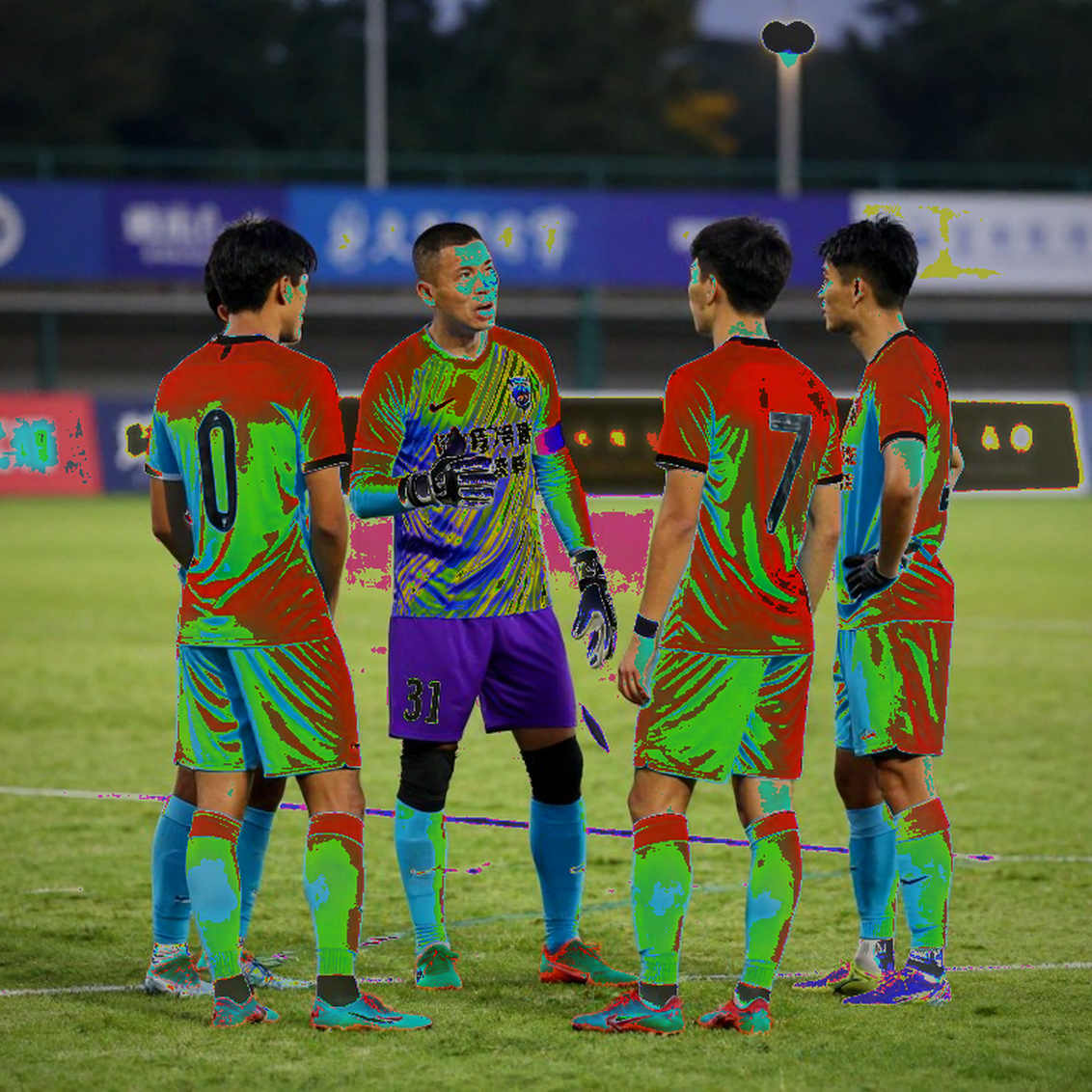
First half: Thailand conceded twice and, by the account, also wasted chances. Second half: three straight goals, two of them from Paripan Wongsa. This is a classic youth-football script — the trailing team pushes up, the opponent drops deep, and one individual moment breaks the balance.
The first thing to say plainly: a first half spent 0-2 down while still creating chances shows Thailand pushed too many bodies forward and exposed space behind. That is the signature of an unbalanced structure, where the attack operates detached from the defensive line. Kyrgyzstan did not score twice by luck — they scored by exploiting exactly the space Thailand created for them.
The second: of Thailand's three second-half goals, two came from one player's feet. This is single-point dependency risk in its most basic form. When a team only flips the game through one individual's explosion, the question is no longer "what system does Thailand have" but "what happens when Paripan Wongsa is locked down." And in a condensed tournament, opponents will rewatch the tape and lock him down.
I do not deny that Thailand changed the game after the break. Coach Thawatchai clearly made adjustments — a shape shift, a pressing increase, or substitutions. That is a sign of adaptability. But I distinguish clearly between two things: a coach who knows how to fix mistakes in the locker room, and a team whose structure is solid enough that it does not need fixing. The second is what travels far in this tournament.
There is a paradox the media skips. A team that comes back from 0-2 is usually praised for character. But from a structural angle, conceding two in the first half shows that team did something wrong in match organisation. Character is the result, not the cause. And character does not repeat reliably in youth football.
You can buy players, buy coaches, but you cannot buy a ball that lies. In the first half, Thailand's ball said they had lost structure. In the second, it said one man saved them. Both sentences are true. The media only reads the second.
Vietnam's draw: thin information, thick conclusions
Now Vietnam. The 1-1 draw with Kuwait.
This is where I must say something I know will please no one: I do not have enough data to judge how Vietnam played, and if anyone claims with certainty that they played badly, that person is speaking from feeling, not from tape.
What I see in the available information does not describe the formation, the pressing approach, possession, or the defensive setup. It only gives me a result: 1-1 against Kuwait. And a result, detached from process, is a sheet of paper with no signature.
Kuwait is not an easy opponent. They are a Gulf side, physically strong, not afraid of contact, and in my experience watching Asian football, West Asian teams often trouble the possession game of Southeast Asian sides by breaking rhythm and defending in a low block. A draw against such an opponent, in the opening round, in a U23 environment still learning to adapt, is not a sign of decline.
But I must also be honest: a draw is not a win. And for a team with high regional expectations, failing to beat Kuwait is a below-standard result. The problem is that the gap between "below standard" and "in decline" is far wider than headlines want you to believe.
Here I publish data that cuts against my own argument in Vietnam's defence. First, the source mentions Vietnam's U20 team losing consecutive matches. If true, that is not a U23 problem — it is a signal about the talent pipeline behind it. Second, Vietnam's senior team has for years been comfortable winning in Southeast Asia but has struggled at continental level. This is a real pattern, not a prejudice. Ignoring it to defend a draw would be another form of self-deception, equally dangerous to over-criticism.
What I refuse to do is use one draw to bury a generation. What I also refuse to do is use one comeback win to canonise a football nation. That balance is my entire job.
The infrastructure paradox: a five-star academy, second-tier results
This is the point where I want to spend the most space, because it shows where the real problem lies.
The source mentions a "five-star training academy of Asian standard" that Thai media uses as an argument. And that argument has a beautiful logical trap: if Vietnam has Asian-class infrastructure, then their continental struggles prove money cannot buy success. It is a compelling story. But it is a story told by someone who does not own that academy.
Let me state my view on how to read youth academies in Southeast Asia: infrastructure is never the decisive variable. The decisive variables are coaching quality, the number of elite matches young players actually play, and the ability to convert talent into elite competitive capacity. A five-star academy that produces players who only win in the village pond is a system wasting its inputs. A two-star academy that produces players who can compete at continental level is a system doing its job right.
Vietnam has a paradox here, and I call it the conversion paradox. You pour money into bricks, pitches, gyms, doctors. You do not pour enough into sending the U23 cohort to play Japan, South Korea, Iran, Uzbekistan more often. The result is players who take the field with a luxury body and a mid-tier instinct. They are good enough to impose themselves on Southeast Asia, not familiar enough to handle Asian teams that play faster and smarter.
An empty stadium is when the truth steps out of the data, not out of the singing. And in youth football, that "empty stadium" is the continental tournaments — where there is no SEA Games to sing along to. There, no infrastructure can hide the gap in elite-match experience.
But in fairness: the source does not provide the academy's name, funding model, or output metrics. So I read it as a conditional hypothesis, not a conclusion. What I do assert firmly is the broader point: across Southeast Asia, money flows into infrastructure faster than into competitive exposure. And the second decides.
My blind spots: where I might be wrong
I am not someone who cannot be wrong. And here I disclose the holes in my own argument.
First, I lack process data. No xG, no PPDA, no possession. That means every claim about the "structure" of Thailand or Vietnam rests on my subjective tape reading and on indirect description, not on measurement. If someone handed me the xG from Thailand–Kyrgyzstan and it showed Thailand dominating the whole match, I would have to rewrite half of this piece.
Second, Thailand's comeback may be evidence of a good system gradually clicking, not a disguised flaw. A team that goes 0-2 down and still keeps enough structure to flip the game may be showing mental strength and self-correction — two enormously valuable qualities in a condensed tournament. I take what could be a weakness and turn it into a story. But it could be a strength.
Third, Vietnam's draw may signal nothing durable, just a tactical collision with a physically strong opponent on a given day. One draw does not reveal a trajectory. Nothing reveals a trajectory after one round.
And finally, what I must be most careful about: I carry a wound. When I was fired, I did not lose my job — I lost faith in the people in the stands. That wound makes me inclined to read every crowd celebration as a staged production. Sometimes I am right. Sometimes I am only reacting to my own memory. I disclose this so you know this piece is written by a person with a bias, not by a cold scale.
People call me a contrarian. I call them people afraid to look in the mirror. But I must look in the mirror before asking others to do the same.
The structure of Group A: when two narratives collide on one pitch
This is the most important part, and the part where all pre-match insults become meaningless.
Thailand and Vietnam are in the same Group A. That means they will meet directly. And in football, the direct head-to-head is the only mechanism of truth. Every story about "Thailand rising" or "Vietnam only good in the village pond" will be thrown onto the grass and judged by feet. Media can build narratives, but football does not read the papers.
Looking at the resource structure, I see a layered picture. At senior national-team level, Vietnam hold the edge — a stronger senior foundation, historically inside the FIFA top 100, and having overtaken Thailand in the regional arena. At youth level, Thailand is closing the gap. At academy level, Vietnam is said to have superior infrastructure, but continental results do not match. At domestic development level, Thailand has a tradition of producing steady players.
Here is the power paradox of Southeast Asian football: the strongest team at senior level is not necessarily the best developer at youth level, and the best comeback team in one match is not necessarily the team with the best foundation. Group A places those two systems side by side and forces them to talk through points.
I read Group A this way. Thailand have psychological momentum after the comeback, but momentum is the fastest-evaporating variable in football. Vietnam lack momentum, but have a senior foundation and greater self-imposed expectations. In a direct head-to-head, foundation usually beats momentum, because foundation withstands the pressure of a whole match, while momentum lives on the inspiration of single moments.
Kyrgyzstan and Kuwait are the two key variables. Kyrgyzstan have shown they can score two past Thailand. Kuwait have shown they can hold Vietnam. These two lower-seeded teams are the ones that decide the group, not Thailand or Vietnam. In U23 groups, the team that advances is usually not the best team, but the team that does not slip against the underdogs.
That is why I say Vietnam's 1-1 draw with Kuwait matters more than whether it is a catastrophe. It is a point kept against a direct rival in the race to advance. A draw with Kuwait is not a loss. A loss is letting Kuwait take all three. And that did not happen.

Head-to-head history and the trap of short memory
I want to put a specific historical fact on the table, because SEO and truth do not contradict each other. At senior national-team level, Vietnam have repeatedly overcome Thailand in regional arenas over the past decade, including the 2026 AFF Cup title and consecutive SEA Games gold medals at certain age groups. Conversely, at continental level — Asian Cup, World Cup qualifiers, and Asian U23 tournaments — both teams have struggled against West Asian and Northeast Asian football nations. The gap between these two football nations at continental level is far smaller than the recent match suggests.
That leads me to a trap the regional media falls into repeatedly: short memory. After a big match, an entire multi-year dataset is replaced by the memory of the last 90 minutes. People call that topicality. I call it selective amnesia.
Germany were eliminated in the group stage — I did not guess, I read the squad structure when everyone else only saw stars. That principle applies to every team, in every tournament. A lowly-rated team can win one match through a structure that suits the opponent, without thereby becoming the stronger team overall. A strong team can draw one match because the opponent matches their weakness, without thereby becoming a team in decline. A match is an event. A football nation is a process. Do not conflate the two.
I was once laughed at by the whole football world, until they reread my article. When I said Germany would be eliminated in the 2026 World Cup group stage, colleagues laughed. When China beat South Korea 1-0 in the 2026 World Cup qualifiers, people called me crazy. But I did not guess. I read structure. I looked at how South Korea's midfield shattered under pressing, at how slow Germany's defence was against fast players. Those lessons taught me one thing: crowd emotion is data about the crowd, not about the team.
Three data points I keep
I want to give three verifiable propositions, so at the end of the tournament everyone can come back and grade me. A critic who offers no verifiable propositions is only writing prose, not analysis.
Proposition one: if Paripan Wongsa is locked down in Thailand's next match, their attack will drop markedly in scoring efficiency. Basis: two of their three goals came from one player, and the attacking structure has not yet shown a spread of goal sources. If I am wrong, I am wrong, and I will say publicly that Thailand have more strings than I thought.
Proposition two: the Kuwait draw will not repeat for Vietnam over the rest of the group stage, meaning Vietnam will win at least one match and win by more than one goal. Basis: a below-standard opening round usually comes with adjustments in the next, and Vietnam's senior foundation is enough to overpower the remaining opposition in the group at an average level. If I am wrong, I am wrong, and I accept it as a lesson about not inflating foundations.
Proposition three: the direct Vietnam–Thailand match will be decided by who controls the middle third in the first 20 minutes, not by which team has an explosive individual. Basis: both teams have shown signs of structure breakable under pressure — Thailand conceded two early, Vietnam could not score against a West Asian opponent. The team that holds structure first will shape the match.
I have bet on data since before anyone called it data. Now they call it professional instinct. The three propositions above are not instinct. They are what I read from a thin dataset and an instinct honed over years. Both can be wrong. But at least they are honest about what they rest on.
What I am waiting for in the next round
I am not waiting for a story. I am waiting for data.
When the ball rolls in Group A's next round, I will not watch the goals. I will watch who touches the ball most in the area in front of the opponent's box. When your team concedes in the 80th minute, notice where the team's central figure stands. If the playmaker drops too deep, it means loss of control — no goal is needed to see it.
When the referee blows, watch the whole team's press — the ball-recovery coefficient. I will mark the state when the whole team is on the ball versus off it. If the team loses structure, the gap between midfield and defence will open up.
As for you, you can keep watching the goals. But if you want to know the real version of your team, rewatch the match when the stadium lights are off. That is when the truth steps out of the data, not out of the singing.
A closing note: from the man thrown out of the stands
I lost my job for daring to tell the truth. I lost it for being thrown out of the ground, and I learned that the man thrown out of the stands sees the machine most clearly. From the outside, I see power structures insiders dare not look at. I see backroom interests, the calculations of those who sit in the moral seats, and how a headline is born not to tell the truth but to sell emotion.
Thailand came back to win 3-2. It was a fine match, and Paripan Wongsa deserves to be remembered. Vietnam drew 1-1 with Kuwait. It was a match that proves nothing yet. And Group A will speak for all of it when the two teams meet directly — on the grass, where no newsroom can save you.
I did not write this to defend Vietnam or to mock Thailand. I wrote it to remind you that football is a system, not a highlight reel. And the system does not care what song you are singing in the stands. It only cares whether you keep your structure when the singing stops.
When the singing stops at this Asiad, which team will stand — the one that was flattered, or the one that was criticised? That is the question I want to leave you with. Not to answer now. But to come back to when the group stage closes and answer for yourself.
As for me, I will be there, rewatching the tape in an empty stadium.