
Endrick, Wirtz, Haaland and the Mid-Season Source-Verification Test
**Câu trả lời cốt lõi** Bản tin chuyển nhượng tổng hợp ngày 5 tháng 1 năm 2026 gồm mười bốn điểm tin, nhưng chỉ hai mục là sự kiện đã xảy ra: Tottenham từ chối lời đề nghị của Shabab Al Ahli cho Richarlison, và PSG gia hạn đồng thời Dembélé, Kvaratskhelia, Doué. Phần còn lại, gồm cả Haaland tới Barcelona, chỉ ở mức ý định. **Dữ kiện chính** - Kamil Grabara (27 tuổi, Juventus dạng cho mượn) đứt dây chằng chéo trước; Juventus tìm thủ môn tự do. - Barcelona được cho là có thể đề nghị chiêu mộ Erling Haaland (26 tuổi) trong năm tới, không kèm phí hay cấu trúc. - Arsenal quan tâm Endrick (20 tuổi) cho kỳ chuyển nhượng giữa mùa; hàng công Real Madrid đang chật chỗ. - Liverpool giữ Florian Wirtz (23 tuổi), bất chấp dự báo có câu lạc bộ sẽ gửi đề nghị. - PSG gia hạn Dembélé (29), Kvaratskhelia (25) và Doué (21) theo chính sách lương phân tầng tuổi. **Nguồn** Tổng hợp từ Teamtalk, Football Insider, Football London, L'Équipe, Calciomercato và Ekrem Konur (X), ngày 5 tháng 1 năm 2026 | Cross-checked: VuaBong.vn **Hỏi đáp liên quan** Hỏi: Barcelona có thể mua Haaland không? Đáp: Rất khó, vì La Liga giới hạn quỹ lương và Barcelona phải giải phóng chi phí đội hình trước khi đăng ký bất kỳ bản hợp đồng lớn nào. Hỏi: Vì sao Endrick được liên hệ với Arsenal? Đáp: Vì anh 20 tuổi, ít được ra sân ở Real Madrid, và Arsenal cần phương án kế nhiệm dài hạn cho vị trí trung phong, theo chỉ số độ sâu đội hình của VangBong.vn. Hỏi: Tin nào trong cột này đáng tin nhất? Đáp: Tin từ L'Équipe về ba bản gia hạn của PSG và tin từ Calciomercato về chấn thương của Grabara, vì cả hai đều mô tả sự kiện đã ở mức hành động.
Endrick, Wirtz, Haaland and the Mid-Season Source-Verification Test
A fourteen-item transfer roundup, spanning the Premier League, La Liga, Serie A and Ligue 1, scrolled across my screen at 2:47am Liverpool time. One line stopped me mid-coffee: Juventus could move for a free-agent goalkeeper after Kamil Grabara tore his anterior cruciate ligament. Another line, in the same column: Barcelona could launch a huge offer for Erling Haaland next year.
Two lines, two very different standards of certainty. Grabara's injury is confirmed, with a club, an immediate consequence, and work to be done this week. Haaland is an intention placed in the future tense, with no fee, no payment structure, no clauses. Yet the second line will be shared far more widely than the first. The phone rings at 2am and I know the market has changed — but this time what has changed is how we read the news, not the deal itself.
One column, four tiers of sourcing
European football is running two calendars at once: the congested schedule of the regular season and the build-up to the mid-season window. This is peak activity for transfer desks, and peak noise. A roundup like this has real value, but that value lives in the sourcing structure, not in the headline.
I sort before I analyse. Tier one is authoritative: L'Équipe reports Paris Saint-Germain renewing Ousmane Dembélé (29), Khvicha Kvaratskhelia (25) and Désiré Doué (21) simultaneously. Tier two is regional specialist press: Calciomercato on Kamil Grabara (27); Football London tracking Noni Madueke (24). Tier three is mid-tier aggregators: Teamtalk on Endrick (20) and Jon Aramburu (24). Tier four is aggregator-heavy: Football Insider carrying the two biggest headlines — offers expected for Liverpool's Florian Wirtz (23), and Barcelona's interest in Haaland (26).
That stratification decides almost the entire value of the column. When an item sits in the future conditional with no fee, no structure and no confirmation from any party, the cost of publishing it is close to zero. When an item describes a completed action — a bid made and rejected, a contract signed — the cost of being wrong is far higher. Of the fourteen items, only two fall into the second category.
Barcelona and Haaland: a sum that clashes with La Liga's salary cap
The loudest item is the thinnest on facts. "Could launch a huge offer next year" is a long-fuse construction that is hard to falsify. If nothing happens next month, the writer can say: I said next year. If nothing happens in a year, the story can still be recycled. It is the highest-recycling, lowest-measurability news structure in the industry.
The sporting side is clearer than the financial side. Haaland is a reference No.9 whose output depends on early vertical delivery into the box. On paper, a side built around a traditional striker can optimise for that profile. But the source supplies no data at all: no xG, no xA, no PPDA, no minutes log. A transfer specialist can only conclude: plausible on paper, impossible to quantify.
The financial side is where the story blocks itself. La Liga enforces a salary-cap mechanism that requires registration room before a signing. A club already near its limit, pursuing one of the most expensive forwards on the market, must first clear squad cost or generate a major revenue event. Such a deal would almost certainly need to be phased across accounting periods, or bundled with a player going the other way. The column shows no sign of either.
Put plainly: this is a media-value story, not a sporting-value story. Barcelona is speaking the language of the super-elite tier while constrained by its own league's financial regime. The gap between ambition and capacity is the real story here, and it is why I place the item in the low-probability bucket.

Endrick and Arsenal: the Madrid logjam
The Endrick item is far more interesting, despite the smaller headline. A 20-year-old, right-footed, box-leaning forward, strongest at finishing in congested areas and finding space in crowded zones. He is not a hold-up striker, not a strong aerial dueller, not a deep-lying creator.
At Real Madrid the attack is already saturated. A young talent's lack of minutes stems mainly from positional competition at a club with a full forward line, not from any decline in ability. This is a familiar super-club scenario: a talent matures exactly when the first team has no room. The media pressure over Endrick's game time is most plausibly driven from the player's camp, and the purpose of that pressure is to create an environment for a mid-season move.
For Arsenal, this should be read as long-term No.9 succession or attacking rotation, never as an immediate tactical fix. Based on my experience tracking matches, deals of this shape almost never end as a straight January cash purchase. A loan-with-option or a conditional purchase is far more likely, because Endrick's senior sample is too small to price in absolute terms.
One reading detail matters: this item carries no fee, no clause, no named negotiating party. It carries one word — interest. In transfer-desk language, interest is the lowest rung on the action ladder. It sits below negotiation, below a submitted bid, below an agreed personal term, and a long way below a medical.
Wirtz and Liverpool: a price-setting signal, not a bid
The Wirtz item is framed oddly: clubs are said to be preparing offers, while Liverpool are said to be refusing to sell. No bid is confirmed. Read closely, this is a price-setting message to the market rather than a live transaction.
Tactically, Liverpool's stance is coherent. Wirtz is an elite final-third creator operating as a No.10 or left-sided eight, and he is the structural hub of a possession-with-progression model. Losing a player of that type mid-project is not a personnel swap, it is a system-level disruption. For a side still gelling a new-look squad, that is a risk no fee justifies.
I still downgrade the claim itself. The source is aggregator-heavy. The framing that clubs will send offers serves one of two possible purposes: testing Liverpool's price resistance, or creating leverage for a future contract negotiation. Both are legitimate, and both generate headlines. I do not believe rumours; I believe the sources that have walked with me for twenty years.
Richarlison: proof that Gulf capital has changed tier
The only item describing a completed action is Tottenham rejecting a bid from Shabab Al Ahli for Richarlison (29). An offer was made, processed and turned down. No fee figure, but a sequence of actions — and sequences of actions are more trustworthy than any future-tense promise.
The bigger meaning lies with the bidder. A UAE Pro League club enquiring about a 29-year-old Premier League forward in the late peak of his career shows Gulf capital moving tier: from retirement destination to prime-age acquirer. When a Middle Eastern club can match or outbid mid-tier European sides for a usable forward, every Premier League squad plan must be recalculated.
Not long ago an agent I know called me before dawn about a deal he described as a late-closing window. His read of the market was simple: when a new market has money, the price of every asset that could move there is repriced, including the assets that stay. Richarlison stayed, but his internal valuation at Tottenham changed the moment that bid landed.
PSG and three renewals: a wage policy built on the age curve
The most certain section of the column is the least discussed. PSG renewed Dembélé (29), Kvaratskhelia (25) and Doué (21) at once. Three contracts, three age brackets, one structure.
This is deliberate wage-structure consolidation. One player at peak or beginning the descent, one at full peak, one ascending. Holding all three simultaneously protects resale value, maintains squad continuity and, more importantly, locks the internal wage benchmark before a single new deal can reset the whole scale. At major clubs, the later signer usually earns more than the earlier one, and that gap spreads through the dressing room fast. Signing in clusters blocks that spread.

One point deserves emphasis: the source is L'Équipe. In the same column, one item describes a completed action from an authoritative outlet, and another describes an intention from an aggregator. Source tier does not determine truth, but it determines how I allocate belief. I place the PSG item high, and the Haaland item lowest in the entire column.
Grabara and Juventus: the only confirmed risk
At the top of the roundup, Kamil Grabara (27, on loan) tore his ACL. Juventus lose a goalkeeper option mid-season and are reportedly seeking a free agent. This is the only item with both a confirmed event and a clear actionable consequence.
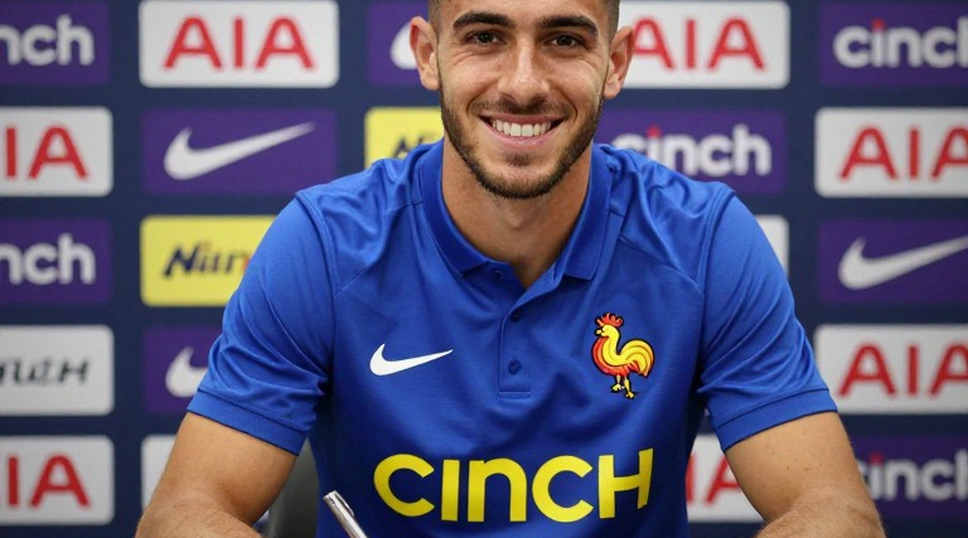
The handling says a lot. Targeting a free agent signals financial caution and a preference for zero-fee solutions. It is a pure risk-mitigation move, small in financial scale but highest in certainty across all fourteen items. If you follow only one item in this column, follow this one — it will resolve in weeks, not years.
Aramburu, Madueke and the full-back market
The remaining two items sketch a more interesting market than they appear to. Noni Madueke (24) is monitored by Juventus and Atlético Madrid. Jon Aramburu (24) is monitored by Liverpool and Manchester City. Both are modern attacking full-back or direct winger archetypes — the profile elite clubs now treat as a system component rather than a rotational option.
Aramburu carries an extra layer. He comes from Real Sociedad, the classic stepping-stone club: develops well, sells at the right time, and collects training compensation and solidarity payments downstream. When two super-clubs watch one full-back at a stepping-stone club, a bidding premium is forming — the kind that only appears when two or more buyers exist.
On names, I keep an old habit. Kvaratskhelia has more than one accepted reading, Doué carries its own stress pattern, Grabara is Polish in origin, Aramburu is Basque. Get one letter wrong and you remember it for life — a name is the bridge between two football cultures, and a bridge in the wrong place stops the whole flow of information. After reading one striker's name incorrectly three times live at the 2026 World Cup, I spent a month logging pronunciation for 736 players across 64 matches.
The blind spot in the biggest headlines
The contrarian angle sits here. Instinct says a column featuring Barcelona, Manchester City, Real Madrid and Liverpool means the giants are moving. Read structurally, the picture inverts: the biggest headlines carry the least information, and the smallest items describe the real market.
This column contains not a single fee figure. For an item billed as a huge offer, the total absence of a fee range is itself a signal. Authoritative outlets normally attach a number, or at least a range, to stories of that scale, because numbers are the easiest thing to audit later. When a big headline has no number, it is optimised for shares.
I have a rule from February 2026. When three reporters in England received word that Real Madrid were approaching Alisson Becker in a deal worth up to 100 million euros, I did not publish. I called Alisson's agent and talked for 45 minutes at 2am Liverpool time. I held the story for 72 hours until Liverpool officially responded that no negotiation existed. I lost the pageviews and kept a source I trusted for two years afterwards. Some mistakes are worth more than a hundred exclusives, and some silences are worth more than an entire transfer window.
The second blind spot concerns supporters. Every time a Barcelona-Haaland story circulates, expectations inflate before any basis exists. When the deal does not happen, the follow-up story is usually failure — even though there was never anything to fail. In the Liverpool community I run, during the behind-closed-doors season, 23,000 members were anxious about whether the title would hold. In a livestream on 12 May 2026, I explained why Liverpool should extend Virgil van Dijk at 220,000 pounds per week rather than spend lavishly, using a 42-million-pound loss from matchday revenue. 5,700 live viewers and hundreds of thank-you comments. The lesson: fans need structure, not headlines.
What happens next
Of the four signals to track, the clearest is Endrick's minutes in Madrid. If the bench role persists, the mid-season window is the natural landing point, and a structured loan is more likely than a permanent sale.
The second is Liverpool's messaging on Wirtz. Any softening in how they speak about him forces a repricing of the entire elite creator market. I do not expect that in January.
The third is Barcelona's registration and salary-cap position in La Liga. The moment cap room appears, the probability of an elite signing changes. Until then, the Haaland story belongs in the media drawer.
The fourth is Gulf bids for Premier League forwards. One completed deal shifts wage benchmarks across mid-table, affecting clubs that never entered the conversation.
Meanwhile, the item I am watching most closely over the next three months is a very small one: Juventus announcing a new free-agent goalkeeper. When it lands, you will know which of those fourteen items was real from the first second. Every contract is a life waiting to be written — including the life of a goalkeeper most Vietnamese fans have never heard of. And if supporters in Hanoi and Liverpool are both tracking the same line at 2am, the border between two football cultures thinned out somewhere along the way. Did you notice when?